Thứ Năm, 12 tháng 7, 2012

A Bitter Summer

Last night, I went to The Youth Theatre (Nhà hát Tuổi Trẻ) to see a play. Its name's "Mùa hạ cay đắng" (A Bitter Summer), written by Nguyễn Quang Lập, directed by Anh Tú and main role played by Kim Oanh.

This play was written over 20 years ago, maybe 1988 when the renovation has been carried out in Vietnam. It seemly became a remarkable play since there. But in the bleak condition of Hanoi stage nowadays, information about new revival of this play doesn't gain many attentions of audience. I know about it just a few hours before play when a friend of mine ask via Facebook that who want to go to see it then she give free tickets. Unfortunately, it seems nobody could go, even her. Someone comments on her status that the play is too old and kind of headache. I have never seen it, so I decided to go. When I go to take the tickets, I was so shocked when she give me 8 tickets!

The play said about one beautiful woman who ran away from an illegal affair around year of 1972 when the North Vietnam suffered the bombing attacks of U.S air force. She lived in a small village with her child (from the affair) and her adopted father. This situation was rather vague. In addition, the first scene was too long but not informative. It made audience feel bored.

But the most important thing here was the characteristic of Thùy Linh - the woman, Trần Hới - the man who was chasing her and the father. They yelled at each other about their sins, lies and betraying in the past. It's a kind of flashbacks but all of them expressed through saying. I dislike this method, it's so simple and boring, especially when the dialogue was not good. It repeated so many same ideas and sentences.
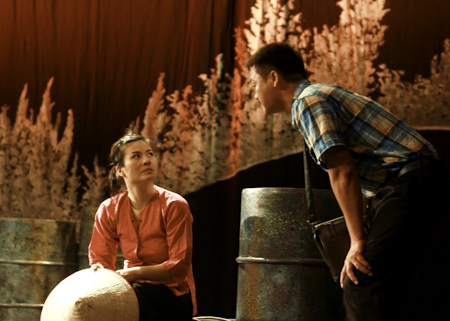

Kim Oanh as Thùy Linh and Quang Ánh as Trần Hới.

Back to the plot. In 1969, the woman felt in love with a soldier name Hoàng when his troop go by the village from the frontier back to Hanoi to repair the arms. He became the meaning of her life and she's waiting for him for years. The soldiers dropped 50 barrels of oil and ask people protect them till they come back. The villagers had to fight the bombing attacks and they lost 12 people for 3 years but no one came back to take the oil away or even communicate them.

Accidentally, Hoàng came back from the frontier. He said that the troop let him turn back to watch the oil barrels. While he and Thùy Linh were guarding the barrels together, he shot a U.S airplane down. But he didn't want to let everyone know it's his victory. When they came back home, he convinced his girlfriend to take it. Unfortunately, Trần Hới who found Thùy Linh already listen to this talk. He discover that Hoang is a deserted soldier. It explained why Hoang did not want to be responsible for the victory.


The 'hot' scene in play

When Trần Hới forced Thùy Linh and the daughter come back to live together with him whether he would tell the truth, she left. I understand the message here is nobody's perfect and full of mistakes. Thùy Linh was a kind of wild woman who used to love Trần Hới because he's "too handsome" and then loved Hoàng, but she's disappointed with her men. Every seemed cheated, maybe, but the simplicity of plot did not persuade me in that message.

However, the talents of main actress - Kim Oanh - solve this play a lot. She could express many emotions, she is also beautiful and her voice is clear. Some verses that she sang are quite charming, it helped audience feel relaxed.

I heard that this play is made just for attending the Professional Stage Festival next month to earn some gold medals, esp. Kim Oanh. Now she's a Superb Artist (a noble title by state authority) at the age of 37 or 38. With the regular in Vietnam, maybe she will become a People's Artist (higher than Superb Artist title), but when? In Vietnam, people call this kind of plays and movies as "Kịch/phim cúng cụ" (Offerings to Ancestors, it means the works made for propaganda, ceremony, memorial...) but nobody buy tickets to see them. So what could I say when I go to theater with 8 tickets for only 2 person? And a lot of empty seats there said all.

Thứ Bảy, 19 tháng 5, 2012

Do and Don't in Hanoi #1

Today I have an idea: why don't I make a list that help you know something should and should not do if you come to my city - Hanoi. I'm aware that there's plenty of guide books already, but  advice from a resident like me could be more updated and helpful for you.These suggestion from what I want to do everyday: Where to eat, how to order, how to avoid some crisis or conflict... in a quite chaotic city like Hanoi.

The first thing is traffic. I think most travelers are scared of traffic in Hanoi. So it comes naturally to the  #1 in my Do & Don't list.

DO:
- Cross the street where has traffic light and crosswalk. Sometime it's not useful, because some naughty vehicles still go under red light! However, you have not any better choice.
- Cross the street where has bridge for pedestrian. There few crosswalk bridges in Hanoi.
- If you see any Vietnamese prepares to cross the street, catch up and follow them immediately. Everyone in Hanoi is congenitally genius in crossing the street!
- If you don't see any sign that the vehicles are about to slow down to allow you go across, you simply wait for another chance. If the traffic is too crowded, it means they have to go slowly and it's become the chance for you!
- Go further to find the way to cross the street.
- Get a taxi. The price for a very short distance is cheap. Of course you must watch if driver cheat you to get much more money than real cost.
- Catch a motorcycle driver ("xe ôm"). If the distance under 2km, the price is around 20,000VND (~1USD). Almost drivers are friendly and enthusiasm.

DON'T:
- Stop in the middle of the street suddenly. I know you will be very, very frightened by traffic, but normally the traffic will slow down and give priority for pedestrians to cross the street. You feel the traffic could hit you at any time, but they will avoid you if you walk fast and confidently.
- Move without steady speed. You shouldn't run suddenly. Drivers may lose their speed control.
- Feel so scary or angry. Vietnamese are usually friendly with foreigners.
- Hesitate to ask Vietnamese people. Not so many Vietnamese speak well English but they know body language enough to show you the way. Except some women carry the burden in Old Quarter or around Hoan Kiem Lake. They are cheaters! (They will give you to try carry the burden, take photos and ask you money without your agreeing).
- Forget a map. If you have a map, you can show your wanted place and ask people which way to get there. And you will be sure it's hard to lose your way unless you go to the place out of the map :-).

Have a good walk!

Thứ Sáu, 18 tháng 5, 2012

Trinh Cong Son & Bob Dylan: 2 difference planets

Here's a new book about Trinh Cong Son who is a famous songwriter of Vietnam, but in a kind of comparison with Bob Dylan who is the man-you-know-who. The book includes original essay name Is Trinh Cong Son's Bob Dylan of Vietnam? by Prof. John C. Schafer (retired, Univ. Humboldt, California, USA), now translated into Vietnamese by his wife - Mrs. Cao Thi Nhu Quynh.

Mr. Schafer taught Comparative Literature in Humboldt, and he has been in Hue, Vietnam where he taught English in 1960s. He has written a number of thesis, essays and articles about Vietnamese culture and Trinh Cong Son. But this book is the first one in Vietnam.

From a very  popular statement: "Trinh Cong Son is Bob Dylan of Vietnam" since late 1960s, and when Bob Dylan have a tour around the world "The Never Ending Tour" which came to Vietnam in only night last year with a message from organizer that "to tribute to Trinh Cong Son," Schafer have willing to discovery whether 2 composers are likely each other.


According to Schafer, we have so many myths but not true. Firstly, that statement is not from Joan Baez, one of muses of Dylan when he's young, after she came back from Vietnam where she share the under bombing condition of North Vietnamese in Hanoi in December 1972. She never went to South Vietnam, where Trinh Cong Son lived at that time.

Secondly, Trinh and Dylan write some songs call for peace, but when Trinh has a lot of anti-war songs in whole Vietnam war time, Dylan write a few protest songs in his debuting time. And Dylan didn't like joining any movement which Joan Baez often encouraged him.

Lastly and most important, Trinh wrote under light inspiration of Buddhism, while Dylan is a Evangelicalism and even composed many religious songs. Two this differences religious let them go to two difference directions. While Trinh Cong Son has a soft philosophy full of forgiveness and love on the themes of broken heart loves, Bob Dylan many times criticized women who get in affairs with him though he betrayed them.

The book also includes the introduction of Prof. Cao Huy Thuan (Univ. of Picardie, Paris, France) and close with a short epilogue which he read in a Trinh Cong Son-remembering concert of singer Khanh Ly who is the legendary voice of Trinh's songs. 

Thứ Ba, 8 tháng 5, 2012

Shopping at the street markets


Nowadays, shopping at street markets still plays an important role in lifestyle of Vietnamese people. The way which they do shopping at street markets expresses how they live in their normal life. In fact, street markets are the face of popular trading in Vietnam.

Vietnamese people find that shopping at street markets has many advantages. Many people go shopping by motorbike, so it is very easy for them to stop at any stall or kiosk without parking their motorbikes. On the other hand, many street markets are next to residential areas, and people feel very convenient to go shopping on foot within a very short distance. They can choose their suitable meat, vegetables or something like that, negotiate the cost and then decide to buy or not. The time people manage their shopping there is very short, because salesmen and customers do not need a receipt for very daily things such as food. Furthermore, the food which is sold in street markets is fresher and cheaper than in supermarkets. If you are a tourist, you will see a colorful picture of Vietnamese life and will learn about its culture when you go through a street market. Shopping at street markets is very flexible, so in a dynamic and developing economy of Vietnam, it is the best choice.


However, shopping at street markets also has some disadvantages. Some street markets invade the pavement and even the traffic lanes. In rush hours, many people come home from work, they go shopping at street markets and contribute to traffic jams. The street markets are dirtier than supermarkets and the salesmen rarely care about keeping their stalls clean. Especially, the food is not always inspected with regard to hygiene. There a lot of pickpockets and cheaters in street markets but the victims cannot complain to anyone. The goods which are sold at street markets don’t have very high quality. Many fake goods are sold there but salesmen never admit that. Worse, some salesmen have very bad behaviors when customers do not want to buy after checking or complaining. Although there are many bad points, Vietnamese people still bear them.


In conclusion, I’d like to say that shopping at street markets in Vietnam has a long tradition in a rural country. People still go shopping like they did many centuries ago. If you learn about Vietnamese style of shopping, especially shopping at street markets, you will know about Vietnamese lifestyle really, really well.

Thứ Năm, 26 tháng 4, 2012

Xe máy tiếu ngạo - Joking rider

It's such a long time to come back to you here.

This month I have a new book which names "Xe máy tiếu ngạo" - in English means "Anecdotes about riding motorcycles" or just simply, "Joking rider". In fact, its name is a kind of parody of a very famous Hong Kong wuxi novel of Jin Yong (Kim Dung). Jin Yong novel's name in Vietnamese is "Tiếu ngạo giang hồ". The Chinese title of the novel, Xiao Ao Jiang Hu, literally means to live a carefree life in a mundane world of strife. Alternate English translations of the title include State of Divinity and Laughing in the Wind.


Of course, my book includes almost funny proses to express the state of "smiling". Half of the book contains proses about motorcycles, about the lifetime of some motorcycles I used to ride. I still choose the way or writing which is lightly humorous so bring the readers a fresh angle on some very familiar topic like motorcycles, city lifestyle, street food, and ridiculous matrix of Hanoi streets and alleys.

Underneath those funny lines is my quest for explaining the transform the behavior of urban people under the impact of traffic and living environment. I also bring to the readers a survey to depict during near 100 years since motorcycles appeared in Vietnam, how they has made effect to Vietnamese society, and whether their destiny will end soon or not. We are just the weird culprit of a reluctantly speedy life!

Number of pages: 176.
Size: 13cm x 20cm.
Publisher: Tre Publishing House.
Price: 45,000VND.

Thứ Ba, 26 tháng 7, 2011

When the tenth month comes


When the tenth month comes (a.k.a The love doesn’t come back, Vietnamese title: Bao giờ cho đến tháng Mười) is probably one of the most remarkable films in Vietnam after American war. It was made in 1984 and was directed by Dang Nhat Minh. Le Van, who used to be Dang’s muse, starred in this film as well as in his other one over ten year later.

It is set in a village in North Vietnam in the years after the reunification of Vietnam where the traditional values still influence people. It is about a rural woman, Duyen, whose husband joined the army a few years ago but his family haven’t received his news since war ended. Finally, Duyen knows that her husband died already but no other one knows this awful truth except a village’s teacher who loves her secretly. She decides to keep the bad news in secret by herself to avoid shocking her ill father-in-law and little son who is desperately waiting for him. She asks the teacher to write some fake letters of her husband and send to her family. This activity helps her father-in-law get well but brings to her many misunderstandings from the conservative community. The teacher writes to her a poem and it makes trouble so that he has to go away from the village. The son, who still thinks his father is still alive, leaves home to find him. On the way, he meets a captain and asks him if the man knows his father. The captain leads the boy back home and then meets his grandfather, who is getting sick again. In his nearly unconscious state, he thinks the captain is his son.

Although the film is black and white, it still portrays many poetic and colorful scenes of Vietnam, which introduces a human and sensitive face of a country which has much loss not only in life, but also in spirit.

Recently, both Dang Nhat Minh and Le Van has published their memoir/autobiography in which said little about this movie and the cooperation between them. According to them, the second film that Dang invited Le Van to star in was not good as their expecting. Nostalgia for countryside [Thương nhớ đồng quê, 1995, based on a well-known story of writer Nguyễn Huy Thiệp] was still a success, but the last one by Dang Nhat Minh which Le Van starred. After that movie, Le Van appeared in another one - The Promise [Lời thề, 1996] - and it was also her last movie. She has never back to silver screen since then. In 2006, her autobiography (Lê Vân: Yêu và Sống [Le Van: Loving and Living, Le Van and Bui Mai Hanh]) became the best-seller book in Vietnam and created a large debate in Vietnamese media. Till now, she is still regarded as one of the most famous movie actresses in Vietnam. Other movies which she plays you should see: Chị Dậu [Mrs. Dau, 1981], Đêm hội Long Trì [Festival night at Long Tri palace, 1990], Kiếp phù du [Evanescent life, 1991].

You can buy English-subtitled DVDs in store. You also can see some parts of Bao giờ cho đến tháng Mười in You Tube with English subtitle: http://www.youtube.com/watch?v=0hNLC_FIapA.

Thứ Ba, 10 tháng 5, 2011

Beneath the shadow of Orpheus

These days, if one were to ask Hanoians, “Which of the city’s architectural works do you most admire?”, nine out of ten would probably respond, “The Opera House.”  Since its inauguration nearly 100 years ago, this building has stood by to witness  every one of the city’s historical events, afforded “front row seats” thanks to its prime central location. One out of ten respondents, however, would be hesitant to recognize the Opera House because of the following issue: the Opera House was built during the colonial period, following the French Classical style of 19th century, a structure forced upon a city under the imperial bootheel.


But until it is joined in the near future by the Thang Long Theater, designed by one of the most renowned contemporary architects, the older, smaller Opera House will retain its striking prominence in the Hanoian’s inner urban map. If you’re getting married, you’ll take glamour shots in front of the Opera House. You can sit beneath the stars in the courtyard of the Opera House, drinking a cup of Highlands Coffee. If you want to drop a lot of bills, go for a bite at Nineteen11 restaurant in the Opera House’s lower level, named for its opening year. Musical rallies and public celebrations are staged in front of the Opera House. At the edge of nearby Hoan Kiem Lake, one can find the intersection of a wide boulevard leading to the Opera House. This stretch of cityscape may be one of Hanoi’s most thoroughly transformed in terms of architectural heritage, as it was once almost entirely devoted to traditional temples of worship. Originally, the land was recognized as a commons between a number of small villages, whose residents would gather there to stage cultural festivities: a role quite appropriately adopted by the Opera House within the cultural life of modern Hanoi. To take in a performance at the Opera House, one usually observes the formalities of such an occasion in the Western style, donning a tuxedo and stuffing oneself into a velvet seat, just as the “woman who went to hear the singers of Đặng village,” from Nguyễn Bính’s poem [1], was similarly dressed to the nines back in that earlier day, well aware that such an event was a rare and special episode in her life.


The Hanoi Opera House on postcard in early 20th century.

It is the architecture of the Opera House itself, however, that exerts its greatest cultural influence. Like the other major building works of the French period, the Opera House exudes majesty and grandeur. In a city devastated by civil war and deprived of its former capital status, whose golden age had since passed, like the “old castle fallen into the shadow of dusk,” [2] the ‘Big Theater’ was a beacon of splendor in those colonial times, legitimating the prestige of the French overlord, but its beauty has remained even after the fall of the regime that built it. The Vietnamese people who first beheld it were exposed to the power of its stately new aesthetics, a counterpoint to the palaces and temples of an indigenous monarchy that had long since waned to the point of only nominal relevance. Of course, the aesthetic principles followed by the Opera House derive from Greco-Roman times, refined and elaborated over the centuries according to the golden ratio, but carrying with them also the ancients’ confidence in their right to conquer any other people they came across. The adornments and embellishments of the Opera House’s roof rise into the sky, its pediments supported by towering Ionic columns that extend from imposing stone feet, and its marble steps open out onto a wide plaza which seems to the suggest that one is approaching a cathedral. The endless reproductions of the Opera House’s image suggest that the structure has indeed conquered the aesthetic sensibility of the population, even if the vast majority of them have never stepped inside of it to hear a performance.

Look back the past time, Vietnamese used to make a cover which has same style as communal houses or pagodas while the interior was very flexible and quite not orderly. And so, for the Vietnamese people today, who have not yet been won over by the modern forms of architecture emerging in Hanoi, the Opera House remains the exemplar of “civilized” style.

Trang Tien Street with the Opera House at the end in 1950s before the fall of French in Dien Bien Phu battle.

But architectural preeminence is just one part of the issue. Buildings such as the Presidential Palace or the halls of diplomatic reception rely upon a flashy sort of splendor, representing a form of power that is still too far from the psychology of the masses and thus from their aspirations as well. And yet, as a cultural landmark, the Opera House still exerts an aesthetic appeal as a proper place for “civilized” activities. Despite its terms having been imposed from outside, the course of cultural progress has seen the Opera House grow on us all the same, peacefully easing itself into the distinctive scenery of Hanoi and the imagination of its public. In those early years after achieving national independence, the first sessions of the National Assembly took place within the Opera House, which went on to weather all the travails of a city at war. After renovations in 1997 to host the Francophone Summit, the Opera House became the city’s most expensive place to hold artistic performances, an unwritten standard against which more modern venues were compared.


Nevertheless, the Opera House is steeped in an outmoded neo-classicism, ignoring the creative innovations of the present, a product of French urban planning, a structure that presses upon the psychological scars of the people of Hanoi. That’s the flipside of the pretty postcards, the ones with sepia photographs of colonial Hanoi complete with old-fashioned buildings and the 36 streets of the Old Quarter.  It can be said that beyond the Opera House, Hanoi is still searching for an iconic structure to call its own, one that is both ennobling and familiar. It’s important to note, however, that people are always lauding the structural perfection of the Opera House, its balance of form and function. The operatic musical genre emerged in the 16th century, when its patronage signified membership in Europe’s aristocratic class. Internally, opera houses were designed to project natural acoustic resonance, but their architectural style always reflected a classical polish befitting the lifestyle, clothing, and social rhythms of the feudal gentry, affectations later acquired and cultivated by the bourgeois class. The performance venues, and culture in general, of Hanoi have not been privy to such luck, since the “dynamic” impulses of modern architectural and social trends seem always to contradict all that has come before. The Opera House will alway be mired in its bygone values, like the beautiful close of a strange, fading season in a country where few material structures can endure for long.


A concert was hold in Hanoi Opera House. As you can see, the auditorium is quite small. It was modeled on the Palais Garnier, the opera house of Paris.

Amid the fever of urbanization, every street in the city is crowded with people, all pressing for a bit of open space. The Opera House has become just such a space for many of the city’s residents, an increasingly popular destination. It’s not just operatic divas who perform at the Opera House; there are also comedy shows and “golden oldies” concerts, such as a recent seven-night engagement by Tuấn Vũ. The Opera House can deliver other sounds as well. There was once a time, during the war, when a loudspeaker installed on the roof of the Opera House would broadcast instructions during air raids. Inside of the Opera House hangs a great lyre of Orpheus, plated in gold during the restorations of 1997. Meanwhile, on the steps outside, one can find droves of young people who gather there every night to chat and hang out beneath the shadow of the winged statues on the roof (also the symbol of the Opera House), gazing out at the lovely scene of the plaza below. This is something that, one hundred years ago, none of us could have possibly imagined.

Nguyễn Trương Quý
(Source in Vietnamese: Phu Nu (Women) of HCMC newspapers, 2010).
Translated by Jacob O. Gold


1. Nguyễn Bính (1918-1966), a famous poet born in northern Việt Nam’s Nam Định province, a committed participant in the revolutionary movement but also well-known for his romantic works. In the poem mentioned by the author, a girl travels to Đặng village to hear the folk-opera singer she has fallen in love with. She wears her prettiest clothing, but is dismayed to find that the man is absent from the performance. 

2. A quote from the poem “Thăng Long thành hoài cổ” (“Thăng Long has become nostalgic” using the old imperial name for Hà Nội-), composed in 1802 by celebrated female poet Bà Huyện Thanh Quan when the restored Nguyễn dynasty shifted the imperial capital to centrally-located Huế.